The Method
Built From 15 Years Inside 2,000+ Recruitment & Executive Search Firms
The Market of One Method™ is the framework. Boardroom™ is where founders implement it with Andy. The Market of One Briefing™ is the conversation that determines fit.
There is one position the market cannot squeeze. The only name in the niche.
Comparable firms compete on price, speed and CV count. The only name doesn’t compete.
It gets paid upfront. Holds the fees. Out-earns firms ten times its size, lean.
That is what The Market of One Method™ was built to create.
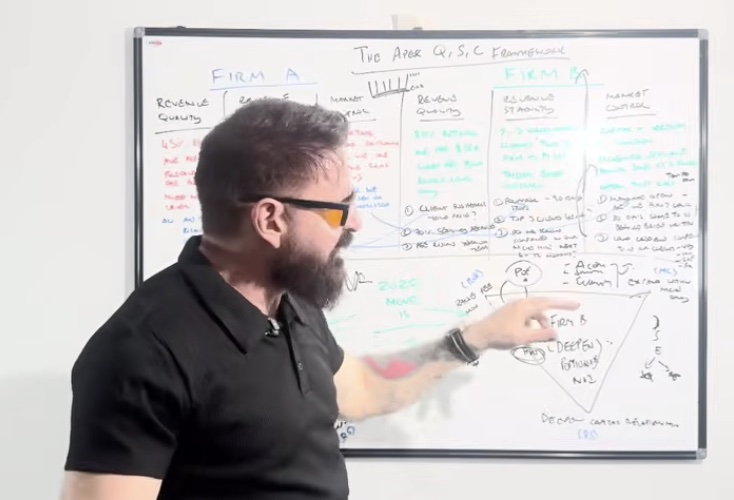
Most Executive Search Firms Become Interchangeable
Same positioning.
Same language.
Same promises.
Same process.
Same clients.
Same fee pressure.
Which means the market compares firms on speed, network, CV flow, and price.
That race gets worse from here. AI accelerates it. Platforms accelerate it. Internal talent teams accelerate it.
The firms that survive that pressure won’t be the firms doing contingency faster. They’ll be the firms operating at a completely different level.
That’s the shift.
The Market of One Model
FIG.05 / THE MODEL
One Centre. Three Moves.
POSITION defines the niche the firm becomes the only name in. Build the name. Authority follows.
COMMAND changes the terms the firm operates on. Premium fees, paid upfront. Money follows.
LIBERATE takes the founder out of the daily machine. Lean systems, no team. Freedom follows.
Each move contains three projects. Nine in total. The full walk-through is inside The Market of One Briefing™.
Where leverage sits in a search firm
FIG.01 / WHERE LEVERAGE SITS
The Goal Is Not To Become “Better”
The goal is to become the only logical choice inside a specific market.
Not one of five firms being considered. The firm.
The one clients associate with the niche automatically. The one trusted before the conversation starts. The one setting the commercial terms instead of negotiating them.
Firms that own a market of one do not compete on price. They set the terms.
FIG.02 / THE POSITION
Once that position is established:
- retained gets easier
- fees hold more easily
- referrals improve
- recruiter leverage improves
- authority compounds
- the business stops fighting for attention constantly
Everything starts reinforcing the same position instead of pulling against it.
That’s what creates pricing power. That’s what creates retained control. That’s what creates firms that become difficult to compete with.
Where The Industry Is Going
Executive search is splitting into two completely different markets.
Increasingly Commoditised
Faster. Cheaper. AI-assisted. Volume-driven. Transactional.
Low-fee recruitment delivered through:
- platforms
- automation
- internal talent teams
- offshore sourcing
- firms competing on speed alone
Margins compress. Differentiation disappears. Clients treat recruiters as replaceable.
Operating Differently
These firms are not selling sourcing.
They’re selling:
- judgement
- access
- market intelligence
- strategic influence
- trust
- commercial leadership
AI does not replace those firms. It increases their leverage. The more automated recruitment becomes, the more valuable trusted human judgement becomes at the top of the market.
This Is The Opportunity
The firms winning the next three to five years will be the firms that:
Own A Category
Define the niche the firm operates inside, tightly enough that no other firm can be confused with them.
Hold Pricing Power
Operate at fee levels that reflect strategic value, not market-rate sourcing. Clients pay because the firm is the only logical choice, not the cheapest option.
Build Authority That Stops Comparison
Become the firm the market trusts before the conversation starts. The market stops comparing alternatives because there aren’t any.
That’s where Apex operates.
What Actually Breaks Inside Most Firms
Most executive search firms eventually hit the same ceiling. Not because the recruiters are weak. Because the structure underneath the business stops scaling cleanly.
- Positioning weakens
- Fees get pressured
- Client control disappears
- Delivery becomes reactive
- Revenue becomes harder to predict
- The founder becomes the bottleneck
Adding more activity rarely fixes any of it. Because these are not isolated problems. They’re symptoms of the same operating model.
These Are Not Separate Problems
FIG.03 / ONE STRUCTURE, FIVE SYMPTOMS
Most firms try fixing these independently. But they are all the same business viewed from different angles. That’s why Apex focuses on the structure underneath the firm itself. Fix the structure properly and everything else starts compounding together.
What Changes When The Model Changes
The business gets calmer.
Forecasting sharpens. Client behaviour improves. Mandate quality improves. Fees stop getting squeezed. Recruiters stop chasing weak searches. The market starts responding differently to the firm.
Most importantly:
The founder stops operating from reaction all day.
That’s the shift.
The Reactive Desk
Operating From Strength
FIG.04 / THE FIRM AS A SYSTEM
Why Apex Exists
The firms making serious money are rarely the firms doing the most activity.
They’re the firms operating from stronger positions. Better mandates. Stronger client relationships. Clearer process control. Higher-trust positioning. Less chaos inside the desk.
That’s the shift we build inside Boardroom™.
That’s the game.
Apply For Consideration
Boardroom™ is intentionally limited. Every founder inside the room is selected carefully.
Apply below and we’ll see if it’s a fit.
Limited intake.